

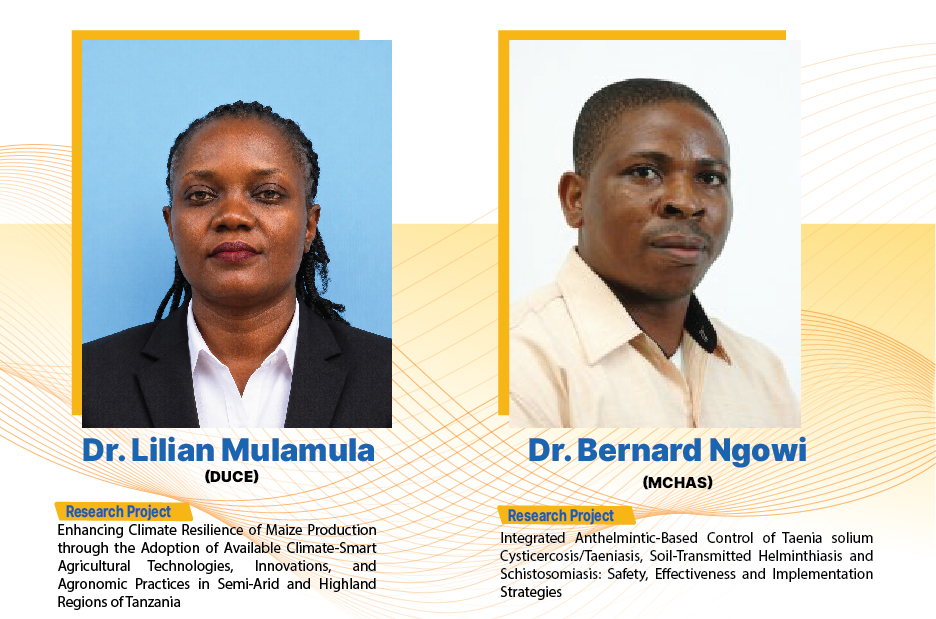
Dr. Mulamula and Dr. Ngowi Secure TZS 3.1 Billion for Climate, Disease Research
By Selemani Nambimbi, CMU
Researchers at the University of Dar es Salaam (UDSM) have secured research projects worth more than TZS 3.12 billion during the April–June 2026 reporting period, boosting efforts to tackle climate-related agricultural challenges and neglected tropical diseases.
The two projects, led by Dr. Lilian Mulamula of the Dar es Salaam University College of Education (DUCE) and Dr. Bernard Ngowi of the Mbeya College of Health and Allied Sciences (MCHAS), are funded by the Tanzania Commission for Science and Technology (COSTECH) and the European Union (EU), respectively.
Congratulating the researchers, UDSM Deputy Vice Chancellor–Research, Prof. Nelson Boniface, commended them for attracting competitive research funding and contributing to solutions to pressing development challenges.
“These projects demonstrate the quality, relevance and impact of research being undertaken by our researchers. I congratulate Dr. Mulamula, Dr. Ngowi and their teams for this achievement and encourage them to translate their findings into solutions that can benefit society,” Prof. Boniface said.
Climate-Smart Agriculture
Dr. Mulamula’s project, titled “Enhancing Climate Resilience of Maize Production through the Adoption of Available Climate-Smart Agricultural Technologies, Innovations, and Agronomic Practices in Semi-Arid and Highland Regions of Tanzania,” has received TZS 351.82 million from COSTECH.
The project will assess climate vulnerability affecting maize production and evaluate climate-smart agricultural technologies and agronomic practices. It will also examine farmers’ readiness to adopt the technologies, establish demonstration plots and develop a climate decision-support tool to help maize farmers make informed decisions.
Dr. Mulamula said the project would provide practical evidence to help farmers adapt to changing climate conditions.
“We want to move beyond identifying the challenges and provide practical solutions that farmers can use. The demonstration plots and decision-support tool will help us work closely with farmers and other stakeholders to test and promote technologies that can strengthen maize production,” she said.
She added that the research team plans to work closely with farmers and relevant stakeholders throughout implementation.
“Our next step is to engage the target communities, establish the demonstration sites and begin collecting the evidence needed to guide climate-smart maize production,” Dr. Mulamula said.
Tackling Three Neglected Tropical Diseases
The second project, led by Dr. Ngowi, has secured TZS 2,768,085,855 in funding from the European Union. The project is titled “Integrated Anthelmintic-Based Control of Taenia solium Cysticercosis/Taeniasis, Soil-Transmitted Helminthiasis and Schistosomiasis: Safety, Effectiveness and Implementation Strategies.”
The institutional collaborative research project brings together researchers from UDSM and partner institutions to develop and implement an integrated strategy for controlling three priority neglected tropical diseases.
It combines One Health, implementation research and pharmacovigilance approaches to assess the safety and effectiveness of interventions and support their implementation.
Dr. Ngowi said the project presents an opportunity to generate evidence that can strengthen the control of diseases that continue to affect vulnerable communities. “Our focus is to develop an integrated and practical approach that can improve the control of these diseases while generating evidence on safety, effectiveness and implementation,” he said.
He said the team would work with relevant partners to ensure that research findings reach communities, policymakers and health programmes.
“We intend to use the evidence generated to support policy advocacy and help strengthen the integration of effective disease-control approaches into national neglected tropical disease programmes,” Dr. Ngowi said.
The two projects reflect the breadth of research at UDSM, spanning climate-smart agriculture, food security and public health, while demonstrating the University’s growing role in generating evidence-based solutions to national and global challenges.
The projects also underscore the value of partnerships among researchers, government institutions, international funders and other stakeholders in turning research into practical interventions and policy solutions.
For the researchers, the funding marks not only recognition of their work but also an opportunity to generate knowledge with tangible benefits for communities and the wider society.